Thursday, February 28, 2008

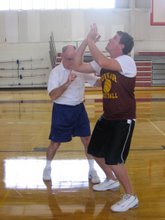
Coaching Youth Basketball: Teaching Progression Skills For 1-on-1, Part 2

Last month's article about teaching progressions skills for 1-on-1 play concentrated on the offensive skills necessary to be able to move and to be able to dribble the ball well, under control.

This month, in Part 2 of this series, I take the teaching-coach to the defensive side of the equation.
**********************************************************************************

Teaching one-on-one skills to young basketball players requires time and patience. If the ball is introduced too soon, too much focus will be on the ball. The child must master balance and body control and be able to move well without the ball. When the ball is introduced, a lot of time must be spent on learning how to dribble and particularly, how to dribble under control. If defense is introduced to play on the dribbler too early, the dribbler will probably not be able to control the ball. Defense, without even understanding the rudiments of stance, sliding, position on the ball, etc., will almost always prevail.

My article in February, 2008, Teaching Progression Skills For 1-on-1, Part 1
http://www.top-basketball-coaching.com/1-on-1-part1, spoke to the teaching of offensive basics for balance, control, ball handling and dribbling. If the youngsters are ready, now the defensive side of the 1-on-1 equation can be introduced.

Just as with offensive skills, the defensive skills must be taught from the most basic—meaning stance, balance and movement—before introducing a dribbler into the mix. A player must understand the role of the defender as being one of containment first, learning to play between the ball and the basket, without thinking about stopping the dribbler or taking away the ball.

For the rest of this article, please go to: http://www.top-basketball-coaching.com/1-on-1part2

Until next month, Yours in Sport & Spirit


Coach Ronn

Sunday, January 27, 2008

Coaching Youth Basketball: Teaching Progression of 1-On-1 Skills, Part I

A couple of months ago, I asked coaches from around the world what they’d most like to know in teaching the individual youth basketball game. The last couple of articles have been answers to some of those questions. This month’s article continues, as part of a 2-part series, about teaching 1-on-1 progression.

Wim C., from Belgium asked about how to teach youngsters progression in 1-on-1 skills.

When people think of 1-on-1 they usually think of an offensive player with the ball vs. a defender. Really, there are two situations to teach-- on the ball and off the ball. This article will only deal with on the ball progression.

Since there are more components in teaching offensive skills than in teaching defensive skills, I will begin with the offensive side of the 1-on-1 equation and cover the defensive part next month.

For the rest of this article, please go to http://www.Top-Basketball-Coaching.com/1-on-1-part1

Saturday, December 29, 2007

Coaching Youth Basketball: Teaching The Art of Using Screens

Happy New Year

My wish, as in every year, is that in 2008 we will have peace in this world, we will find our global society coming back to The One, that we will wake up and realize the pain we have caused Mother Earth and begin to do our individual parts to help Her heal.

Deep Peace to you and yours!

This month's article is my reply to a coach named Wim C., from Belgium.

Coaches write to me with questions relevant to the age groups they work with and to their youth coaching experience. It doesn’t seem to matter where in the world these coaches write from, their questions are echoed by dozens, if not hundreds of other youth coaches around the globe.

In order to adequately answer the questions I received from Wim, who works with 6-10 year olds, I am going to need more than one article. Coach C. asks: “How do you teach the progression in one-on-one play, (in both) offense and defense?” He also asks, “At what age do you start using screens?”

In this article, I'll answer the easier question about when to start teaching screens.

Screens are not for inexperienced coaches and very young players. They are time consuming to teach correctly and drill, so they are best left to coaches who know the rules and functions for screens and for players with enough experience to quickly pick up the fine points of screening and using screens.

Probably, age 10 is too early for most players. First, they have to be made to understand the purpose of the screen and how it works for that purpose. They will need to be shown how to correctly set a screen and told what the rules regarding screens are--close screening, moving, etc.

The easiest screen to begin with is one made away from the ball.

To read the rest of the article, go to: Teaching Screens

See you next month, when I answer Wim's other question about teaching 1-on-1 progression.


Friday, December 7, 2007

JUST IN TIME FOR CHRISTMAS

Basketball On A Triangle: A Higher Level of Coaching and Playing


JUST IN TIME FOR CHRISTMAS
The long awaited book is available for download now--
Buy It Separately or With The Streaming Video

By Coach Ronn Wyckoff
This is the book that launched the highly popular DVD and Streaming Video by the same name.

Tuesday, November 27, 2007

Coaching Basketball: Teaching Defensive Transition

I surveyed my Spiritual Hoops subscribers during November, asking coaches what their most pressing 'need to know' was right now. I was surprised by the number of responses from around the world, and I will begin to answer some of the questions with my December newsletter.

I will still entertain more responses from my readership and I encourage coaches to submit their questions.

Coach Anindya, from India, asked how to train his players to get back quickly on defense. I thought this was a question I should deal with as an article, because I have had this question asked before.

This is more of a team issue than an individual issue, and while I try to maintain my focus on only teaching individual aspects of the game, the transition issue relates to both the fast break and rebounding—areas I have covered in my e-books and DVD/videos. So, I decided to offer my thoughts on how Coach Anindya might help his players transition to defense more quickly.

If that is a concern for any other readers as well, the article can be read in its entirety at
http://www.top-basketball-coaching.com/December_2007.

Yours in Sport & Spirit,

Coach Ronn

Monday, November 19, 2007

Bonus Book--Station Drills

Hey, here's a bonus for you! Originally there was to be a chapter 15 in my book, Basketball On A Triangle: A Higher Level of Coaching and Playing. I took it out, and now there's an additional, stand alone ebook that just was published.

Basketball coaches everywhere bemoan the lack of practice time. Too, every coach seems to need more time for his/her players to practice fundamental skills. Because it takes up so much of every practice just to work with the team aspects, too often the individual skill practice time gets short-changed.

In this latest ebook, I give coaches a solution for this time and individual skill teaching dilemma.

Years ago, I devised a plan where in 15-20 minutes of practice time we could cover all the basic individual skills, so the rest of the practice time could be used for teaching the team aspects of the game.

To read more about this book, use this link: http://www.top-basketball-coaching.com/stationdrills

For all my ebooks, mentoring programs, DVD/videos, and articles, please visit
http://www.Top-Basketball-Coaching.com

Yours in Sport & Spirit,

Coach Ronn

Wednesday, November 7, 2007

Coaching Youth Basketball: Teaching Position Specific Skills

Now you've got completion! This book wraps up all the other books by Coach Ronn that taught all the basic skills:
Balance and Movement; Passing; Dribbling; Shooting;Rebounding;
Moving Without the Ball; Moving With the Ball; How to Play Defense…

After you've taught the basics…

What Comes Next?

You teach: Position Specific Skills!!

In Teaching Position Specific Skills, you'll learn how to teach…

  • Offensive attacking and finishing at the basket;
  • Defensive specifics to the player position—positioning, over play/denial;
  • Specifics common to both inside and perimeter positions—shot-blocking, cuts, flashing the post, and moving with the ball;
  • Getting the right attitude for success;
  • All the position skill work necessary to take your players to a higher level of play.
Get all the information about this new book...AND, there's a video available too that covers all the action being taught.

For all the details, go to: Teaching Position Specific Skills